When you dislodge a plant form where it has been growing, it damages the tiny root hairs that are used to absorb water and nutrients. That is why they undergo some form of transplant shock when relocated. The plants could look a little wilted, or they may not take on noticeable new growth for a few days as they repair the root damage. They need some time to regrow the tissue damage and get a hold on the new soil. There are some things you can do to prevent damage, such as handling the plants carefully. Don’t be afraid of transplanting though, it will be more damaging for the roots to become root bound by growing in too small of a space.
Pot size
*Plants become root bound when they remain in too small of a pot for too long. The roots grow in circles and become knotted up. This is bad for the plant because there is generally no longer enough nutrients in the pot to feed the plant. They can either starve, or, it will become very difficult to keep the soil moist enough. This also damages the root function, not allowing proper absorption of water and nutrients properly.
Some signs that your plant may be root bound include thick roots poking out of the bottom of your pot through the drainage holes, visible bands of roots at the surface of the soil, discoloration of the leaves, wilting, and needing to water your plant (a lot) more than usual. The plant can sometimes be saved by re-potting to a bigger size immediately. You would have to break up the root ball gently so it can grow in different directions.
Besides having too small of a pot, it is also possible to have one too big. If your pot is very big for your plant, it may be difficult for the roots to reach and absorb water and nutrients. This could lead to disproportional growth with the plant lending most of its energy to getting the roots to grow deeper. Although this scenario is the lesser of two problems, it should still be avoided. Use an appropriate size pot to reduce the likelihood of future problems.
My rule of thumb: I usually try to transplant so that there is a few inches of soil underneath the tips of the roots.
Timing
There is no exact amount of time after planting a seed that it has to be moved by. It is a bit relative and you have to use your judgement. I like to go by
- How many leaves the plant has
- Observing the overall health of the plant
- How crowded the tray is looking
It is important to note the distinction between “first leaves” and “true leaves”.
First leaves are what people call the very first thing you see when green emerges from the soil. These are more technically called cotyledons. They are actually part of the seed and store energy from the seed. In the picture below, you can see that the seed is still attached to one of the cotyledons.
I always have an urge to pick those off, but I tend to leave them attached because they may still be providing energy to the growing seedling. They will fall off eventually on their own. As the plant grows, the whole cotyledon will fall off as well!
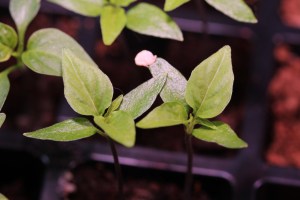
Some cotyledons are photosynthetic, but at this point, the plant is surviving mostly off of stored energy and could survive on little to no light. Before it grows true leaves, it is more important to have good moisture and warm temperature, but if you do not have lights on them yet, it would be a good idea to start getting them set up! Definitely set up lights if your plants are not growing straight up. They should not be leaning over.
The true leaves are the actual new organ of the plant which is photosynthetic.
Some cotyledons look similar to the true leaves of the plant, and some look completely different. It is often more difficult to identify a plant by the cotyledons that emerge, than when they get the first set of true leaves.
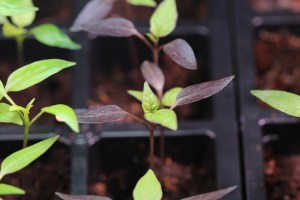
To accentuate the difference, here is an heirloom seed I planted called a Jigsaw pepper. New growth starts green then turns purple! I was interested to find that the cotyledons did that as well. In the picture below, the purple “leaves” are actually the cotyledons, and the green ones are the emergence of the first set of true leaves!
Why the botany lesson?
It is important to know the difference because that is how you know when the plants are ready to be transplanted! You can have faith that the roots are strong enough for transplanting when the first or second set of leaves have developed and the plant looks sturdy and healthy!
One more helpful tip: I planted 2 seeds in each cell of the tray and in many cells, both seeds grew. Some people thin them out by clipping (not pulling!) the weakest one, but I am going to attempt to keep as many as I can. The problem with that is some of the seeds which germinated first or grew faster are now starting to shade out the smaller ones, making them stunted. That is a another good indication that it is time to remove and re-pot.
I am transplanting about 5 weeks after planting the seeds, for some reference. All of my seedling have their first leaves, and some are growing the second set. They are all different sizes. I am going to attempt to remove the big ones, and allow the little ones a few more days to grow.
Tune into the next post for my transplanting technique!
 Homepage